How to Use Speechify for Grading Without Burning Out
Of all of the struggles my community members tell me, grading is near the top.
I get it. It was for me, too.
You might have a very thick stack of papers or docs to get through.
But even with the best of intentions, it can feel pretty impossible.
You are not broken. Your brain, if you're neurodivergent, works in unique ways.
Your executive functions work differently, but that is something you can support.
One of my favorite self-accommodations is Speechify, a text-to-speech AI tool.
Let me show you how you can use it to help with grading.
TL;DR
Grading as a neurodivergent teacher can feel overwhelming; but that does not mean you are lazy or bad at your job.
Tools like Speechify let you listen to student work instead of staring at a stack of papers, so your brain has less friction and more focus.
You can pace, organize your teaching areas, or shuffle papers while you listen, and still give thoughtful feedback without chaining yourself to a chair.
I like to think of it as giving your own brain the kind of accommodation you would gladly give a student.
If you try one tiny thing, copy a single paragraph into Speechify, press play, and see if your grading load feels even a little lighter.
This article contains affiliate links. If you purchase through these links, I will earn a small commission at no extra cost to you. Thank you for your support!
Why Grading Feels Overwhelming
Grading is not a one step process.
As much as we love technology, this is something that you have to make sure you're still thinking critically about.
It is a multi-step process.
You've got organizing papers or electronic documents.
Then you have to start the work, stay focused, remember the rubrics, and finishing.
And then actually hand things back.
That's a lot to handle in one sitting.
And in fact, if you are trying to do that, it's likely you're burning out.
And not able to sustain that system.
For good reason… it's too much for one day.
And breaking things down into steps is challenging.
Especially if you are afraid you will forget to come back.
Or if you're afraid you won't finish it.
All of this can add up and make it even harder to want to start.
Again, I get it.
As a former elementary music teacher, I had hundreds of students to keep up with.
It wasn't easy!
Impact on Students and Teachers
When you get behind, there's a ripple effect.
Students don't get their work back in a timely manner.
Papers are more likely to be misplaced.
And you feel terrible!
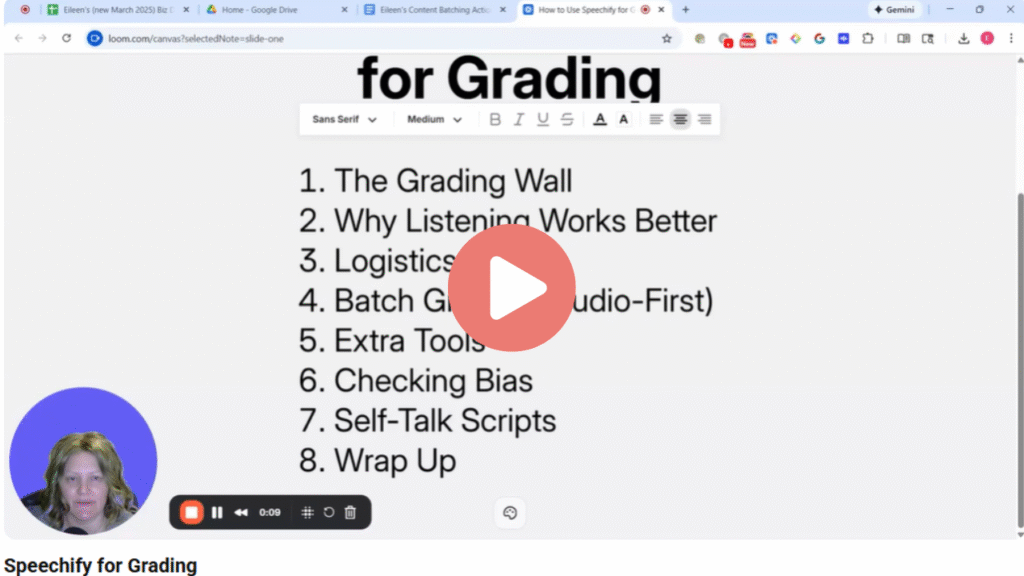
Speechify for Grading Help
Speechify lets you listen to student work.
Clearly this is beneficial if you are visually impaired, have dyslexia, or other reading difficulties.
Having it read to you can really decrease the stress required to get through it.
In turn, you will have more time and energy to return the work faster.
And you'll feel better about yourself as a teacher.
The Strength of Listening
For many of us, myself included, listening to a text is easier than reading it.
Do you feel like you absorb material better when you're only listening to it?
I do.
And I also think it can feel better pressing start than delving into the paper abyss.
If you want a fuller overview of the tool, you can check out this Speechify guide for busy teachers.
Move and Multitask for Better Focus
You might focus better when you are up and moving around.
You can listen to work while you organize your pencils, or walk down the hallway.
If you're at home, you can listen while you attend to laundry.
(Oh dear, not that again!!)
Sometimes when our hands are busy, our brain just does better.

Easy Ways to Import Student Work into Speechify
You have options for getting student work into Speechify, so pick the one that feels easiest in the moment.
Copy and Paste Method
On your computer:
- Open the student essay or doc.
- Select the text.
- Copy and paste it into Speechify.
- Press play and start listening.
Upload PDFs and Images
You can also upload PDF files of student writing.
Take photos of handwritten work or your own notes.
Speechify can read from those files once they are imported.
Chrome Extension for Google Docs
If you use Google Docs, the Chrome extension lets you listen right from your browser.
You open the doc, click the extension, and it starts reading.
Quick Tips for Batch Importing
Try “batching” your grading.
Import several pieces at once, and treat it like a grading playlist you will listen to over a set time.
Set a timer and take a break when it goes off.
Write down where you were when you stopped.
As well as, where you want to start next time.
Trust me, you won't remember!

Best Practices for Safe and Efficient Use
A few simple habits can keep this process smooth and safe.
Protect Student Privacy
As best practices, avoid uploading documents that contain highly sensitive or identifying information.
If your school has rules around this, honor them.
Always check in with your school's tech integration team or admin.
Want to learn more about how Speechify can support your students?
Check out this overview of Speechify's education benefits.
Tools to Pair with Speechify While Grading
Grading works best when you have a few other tools ready.
Rubrics and Checklists Ready
Before you start, have your rubrics, checklists, and a simple way to keep notes.
Keep a notebook open so you can record short ideas while you listen.
Over time, this can become a routine: load up the work, press play, move your body, mark the rubric, repeat.
Reduce Bias with Anonymous Grading
You can also use Speechify to experiment with anonymous assessments.
If possible, remove student names or shuffle the order of the work before you import it.
That way, you are listening to the writing without knowing who it is.
This can help you notice patterns in how you grade.
Do you judge more harshly when you expect a “strong” student?
Does a quiet student surprise you when you do not know who wrote the piece?
Overcoming Hesitation to Start Grading
If you feel resistance to even opening the app, that's okay.
Task initiation is hard with ADHD.
You might also find support in these starting tasks with ADHD tips.
You are not lazy for avoiding grading.
You likely have built up over time some very valid reasons for why it is difficult.
Here are some more ideas from ADDA on ways to support motivation and productivity with ADHD.
Self-Talk Scripts to Try
When you feel yourself hitting that wall, try telling yourself:
- “I can pause whenever I want.”
- “I am only listening, not finishing.”
Sometimes that can help.
I know this brings up its own anxiety.
But the point is you want to lessen the pressure enough to get you making progress.
Build Momentum
Set a timer for 5 or 10 minutes.
Listen to one or two pieces.
Stop on purpose, even if you could do more.
Let your brain see that grading can have a clear end point.
Reward Yourself for Progress
Your brain loves dopamine.
But neurodivergent people's brains tend to have a hard time regulating it.
If you can, try to build in some small rewards to help with this.
You might grab a coffee from your favorite spot.
Listen to a favorite song or playlist.
Use a fun sticker or checkmark on a tracking sheet.
Or something else that reminds your brain you're doing the thing!
Rewards are important.
Your brain needs that positive feedback in order to stay motivated.

Audio as a Valid Accommodation for Teachers
You are allowed to support your own brain at work.
Audio is a valid accommodation for students, and it is just as valid for you.
You do not have to earn the right to use tools that help.
Prevent Burnout Effectively
When you batch tasks, use tools, and lower barriers, you protect your energy.
You may even feel like it's easier to stay in teaching longer.
I'll be the first to admit that burnout is not a simple situation.
And it takes time to come out of it.
But finding ways to make your daily tasks feel more manageable, is always a good thing.
Final Tips for Making Speechify Work for You
Start small.
Try listening to one student piece with Speechify and notice how you feel.
Was it less draining that usual?
That's great!
If it helps lower dread or makes grading even a little easier, you can build from there.
You deserve support that matches your capacity.
You got this!
Read this post to learn more about what Speechify can do.
Visit this link to sign up for your free Speechify trial.
Join the Community
Do you personally have ADHD/autism and want to connect with other like-minded educators?
We share ideas, ask for help, vent, and generally support each other.
Visit our Facebook group and take it one step at a time. Please answer the quick questions and have a clear photo. That helps keep the community safe. Thank you.
You've got this! ❤️
Found Something Helpful? I'd Be So Grateful If You'd Pin One of These Images!
It truly helps my blog reach more teachers like you. Thank you so much!