5 Simple Steps to Selling Teaching Resources Online
TL;DR
Selling teaching resources online lets you turn the lessons, worksheets, and activities you already use into digital products that can earn money over time.
Without adding more face-to-face work to your day.
As a neurodivergent teacher, you focus on one platform, start with your “greatest hits” lessons, and use simple supports like templates, checklists, timers, and body doubling.
With some basic marketing and realistic expectations, your store can grow slowly in the background while you attend to other responsibilities.
This article contains affiliate links. If you purchase through these links, I will earn a small commission at no extra cost to you. Thank you for your support!
You spend a ton of time making solid lessons, worksheets, and activities for your students.
Then the bell rings, the papers get shoved into your bag, and your hard work just sort of vanishes into the day.
What if you could take that same work and let it earn for you again?
That is what selling teaching resources online lets you do.
You reuse what you've already created, share it with other teachers, and, over time, build digital income.
That does not depend on showing up in person every day. (Winning.)
If you have ADHD, autism, or both, this can be a more brain-friendly side hustle.
You get to use your creativity, work at your own pace, and avoid face-to-face exhaustion.
In this guide, we'll look at simple steps to get started, plus supports to help if executive function is whacky.
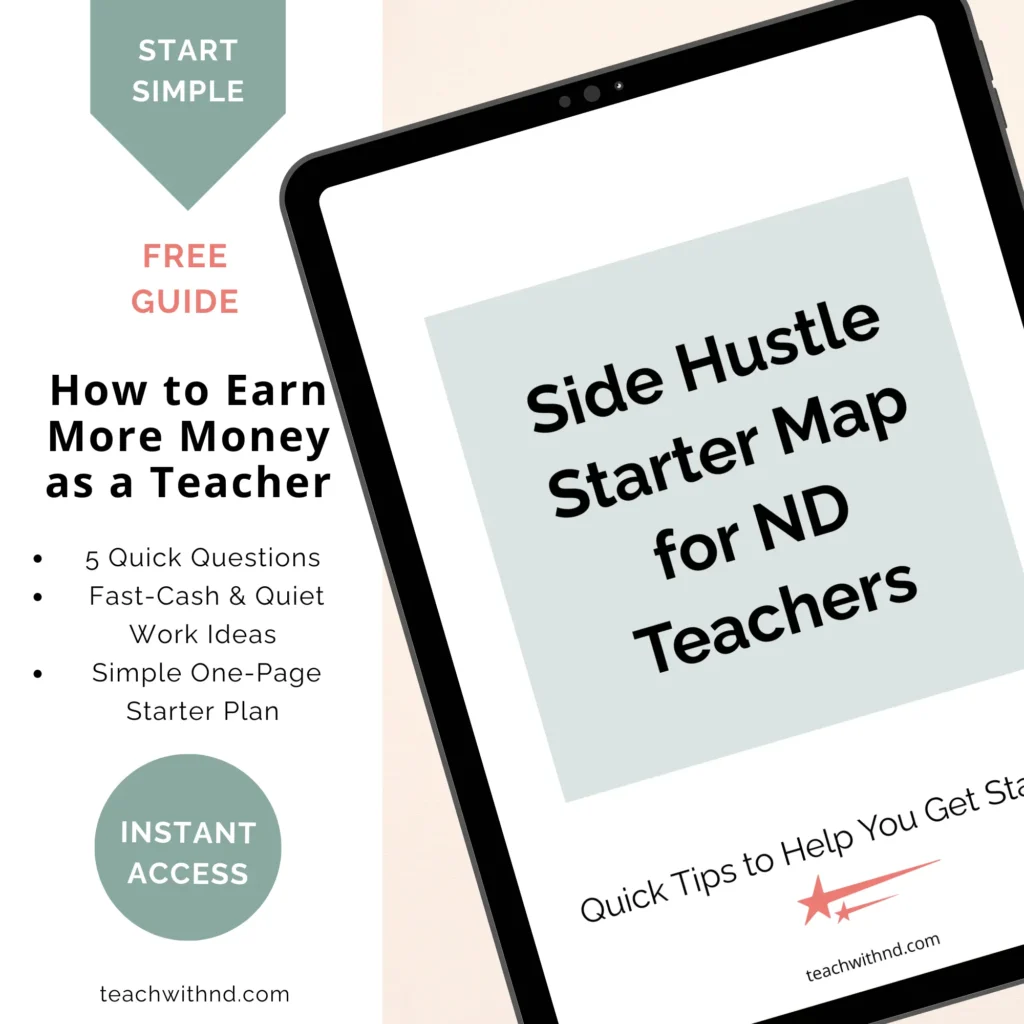
Get My Free Side Hustle Starter Map for Teachers!
Thinking about a side hustle, but running on fumes?
This quickstart guide is for neurodivergent teachers who want to earn more without burning out.
Use the Side Hustle Starter Map to:
- Check your energy + social battery
- Explore ideas based on your needs
- Pick a starting place…even if it's not perfect
You can make extra income in a way that honors your time and emotional bandwidth.
This free map will help you get started.
You don't need to be super organized or on top of everything to do this.
You do need to have a small, repeatable process that respects your brain.
Let’s build that together.
Why Selling Teaching Resources Online Can Be Great For ADHD and Autistic Teachers
You know that feeling when you pour your heart and sole into a project, then use it once or twice and move on?
When I was working as an elementary general music teacher, this was my life.
Months of practicing and preparation, all over in less than 30 minutes.
Selling materials online lets you reuse work you already did instead of starting from scratch.
Overtime it can help you earn money without more in-person hours or meetings.
It lets you work in quiet, solo time, which can be a relief if you are peopled-out by the end of the day.
Plus for those of us shiny object seekers?
You can't beat the constant stream of novel, challenging ideas to pull from.
You get to turn your favorite lessons into products.
You can tinker with design and layout.
You solve problems for other teachers who are tired and busy, just like you.
This is also one of the more flexible side hustles.
You can work in short bursts, take breaks when your energy dips, and come back when your brain is ready.

A Quick Reality Check About Money
Selling teaching resources online is not gobs and gobs of fast cash.
If you need money this week to cover groceries, something like food delivery will give you better results.
A digital shop works more like a slow-growing garden.
You plant seeds now, water them a bit, and over months and years, you can see growth.
So instead of asking, how can I make five hundred dollars this week?
You might ask, what can I create this month that could keep earning in the future?
That's an important point to keep in mind.
Particularly when so many of us in modern-day society want things noooooooooowwwwwww!
(As in, yesterday.)
If you want more support with the ADHD side of teaching in general?
Check out this ADHD accommodations checklist for teachers.
It has ideas for supporting both you and your students.

Step 1: Choose a Platform and Stick With It (For Now)
You have probably seen teachers selling on Teachers Pay Teachers or Etsy, and more.
Your brain might already be thinking, I should do all of them!
I can do alllllllll of them!
Please don't.
At the beginning, choose one platform and stay with it.
This is until you know how to create a product, upload it, make a basic cover and description, and get a few items live in your store.
Teachers Pay Teachers (TpT) is a common starting point, and many teachers have success there.
But the exact platform is less important than your ability to learn one system at a time.
Although I'm new to creating on TpT myself, I speak from my experience as a digital creator and blogger.
I've learned it's better to stay consistent with one social media platform, for example.
For those of us who tend to jump in head first and ask questions later?
Put some limits on your options. Trust me.
Otherwise you might not be as productive as you'd like.

Why “One Platform Only” Helps Your Neurodivergent Brain
If you have ADHD or autism, you probably already know too many choices can bring about decision paralysis.
Plus, task switching drains your energy fast.
Sticking to a single platform cuts down on new logins and dashboards.
It lets you reuse the same steps over and over.
It gives you a sense of progress instead of constantly reinventing the wheel.
(If you're like me, you're already a pro at this.)
So, you're really not limiting yourself.
You are protecting your energy reserves, so you can follow through.
Step 2: Decide What To Sell First (Start With What Already Works)
You don't need brand new resources to start.
Your best starting point is what's already working for you and your students.
Think about activities your students love or ask for every year.
For example what are their favorite games?
Do they enjoy centers?
For example, when I taught elementary music, there were certain dances and games that my students asked for year after year.
(Seriously, what *is* it about Let's Pass the Pumpkin?!)
Those were reliable, strong, tested, and joyful.
Students knew them so well, I didn't have to do much direct instruction at all.
If I were turning my lessons into products, that is where I would begin.
You may have your own versions of those.
A reading response template that finally clicked.
A math review game your kids beg to replay.
A social skills activity that calms the whole room.
Start there.

A Quick Way to Choose Your First Resources
Ask yourself what students request most often.
What do I feel secretly proud of?
What lesson or activity would I happily teach again tomorrow?
Pick one to three of those as your first product candidates.
You are not promising to make them perfect.
You are just picking a starting point.
Step 3: Create Repeatable Routines and Simple Templates
This is where you protect yourself from burnout,
Instead of reinventing the wheel for every product, you set up repeatable routines.
Like a basic checklist, a standard cover template, a simple mockup style you reuse, and a consistent work rhythm.
You can batch around your energy level, too.

Break Your Process Into Tiny Steps
When you are learning how to sell teaching resources online, each step can feel mysterious.
Breaking it down helps your brain see a clear path.
For example, one product might look like this.
Choose one classroom resource to start with.
Clean it up for other teachers.
Check spelling, remove student names, add an answer key if helpful.
Of course check any copyright issues and don't resell stuff that you're not supposed to.
Create a simple cover in Canva or a similar tool.
Export your file as a PDF.
Upload to your chosen platform.
Write a short description that explains what it is and who it's for.
Set a price.
Hit publish, even if it's not ‘perfect.'
(Spoiler alert: It never will be.)
If decision-making is hard or your to-do list overwhelms you?
A tool like this free ADHD task prioritization tool for teachers can help you sort these steps into a clear order.
Use Templates To Save Your Energy
You might decide that for the next month, you will use the same cover layout.
You will stick to two main fonts and one color palette.
Your product descriptions will follow the same basic structure each time.
This is not boring.
It is being kind to your executive function.
The less time you spend deciding on fonts and colors, the more room you have to make strong content.
Or rest when you need to, and actually upload the thing.
You can always refresh your designs later, once you have a small catalog.

Step 4: Use Simple, Low-Pressure Marketing
You do not need a full social media strategy to start.
Trying to be everywhere at once is a quick way to get stuck.
Instead, pick one platform and one realistic goal.
For example, let's say your platform is Instagram. Goal is one short video each week.
You could show a quick preview of one resource.
You could share a fifteen-second tip on how to use it in class.
You could talk about what you love about the lesson or why you created it.
You are not becoming a full-time influencer.
You are simply giving people small, regular reminders that your resources exist.
Once a week adds up fast.
When it feels easy, you can always do more. You are allowed to keep it small.
You're helping others, too, by giving them accessible content that you know is solid.
Step 5: Build ADHD-Friendly Systems Around Your Store
Selling teaching resources online is not just about files and covers.
It's also about helping yourself start, continue, and finish tasks on time.
Use Checklists For Your Product Workflow
Your brain has enough to remember.
Offload as much as you can.
Create a checklist for steps you take each time.
Include each step, even the small ones, like open the platform, upload the file, double-check the preview, and hit publish.
Put a sticky note near your computer that says, check the product checklist.
It may sound silly, but it works.
SOPs for the win.

Set Timers and Protect Your Focus
Timers can be helpful if you struggle with time blindness, hyperfocus, or getting lost in the minutiae.
Try working in twenty-five minute blocks with five-minute breaks.
Limit yourself to one hour of product work at a time.
Use a visual timer so you can see time passing.
This helps you avoid spending three hours adjusting one font and then running out of energy.
Try Body Doubling For Accountability
Body doubling means working at the same time as someone else, either in person, on a video call…
Or even in a coworking space.
You definitely don't need to talk.
Just note what you are going to do, work, and check in at the end.
That little bit of accountability can be enough to get started.
Keep an Idea Parking Lot
Your brain will absolutely give you new product ideas when you are in the middle of something else.
Instead of chasing every idea, create one spot to hold them.
That could be a notebook, a notes app, or a Google Doc.
Label it ‘Product Ideas.'
Write things down, voice record, or draw.
And come back later.
Your focus stays intact, and your ideas don't get as lost.
Yeah, you still might lose some, but having a constant catch-all place is a good idea.
Step 6: Think About Profit Without Losing the Joy
This is a side hustle. Money matters. You are allowed to care about that.
You can balance joy and profit by asking two questions.
Do I like this enough to spend time on it?
Is there some evidence that other teachers want it?
You can search your platform for your subject or grade.
Notice what keeps showing up.
Look at what has reviews or is marked as popular.
That gives you hints about what people actually need.
Then you can decide if something you already have meets that need.
You are not copying. You are connecting what you do well with what is useful to others.
That overlap is the sweet spot.

If Perfectionism or Overwhelm Is Bothering You
Let's be honest. You might know all of this and still feel frozen.
Maybe your thoughts sound like this.
“I will start when I have a full brand figured out.”
“I should learn everything about SEO first.”
“If my first product is not amazing, that means I am not cut out for this.”
But guess what?
That's perfectionism talking, mixed with executive function challenges.
Your job is not to make the most popular trends right out of the gate.
Your job is to get one product live.
Instead of starting a store, try picking one resource you are likely to buy.
Set a time box.
Work on it for thirty minutes and then stop.
Aim for good enough.
Tell yourself this version is allowed to be basic.
You can always edit a product that exists.
You cannot edit one that's still up in your head!
Okay, you can try, but… that just sounds messy.
Join the Community
Do you personally have ADHD/autism and want to connect with other like-minded educators?
We share ideas, ask for help, vent, and generally support each other.
Visit our Facebook group and take it one step at a time. Please answer the quick questions and have a clear photo. That helps keep the community safe. Thank you.
You've got this! ❤️
Bringing It All Together
Selling teaching resources online is not magic, and it's not only for super-organized people.
It's a slow, steady way to turn the work you already do into something that supports you over time.
You've learned how to:
pick one platform,
start with what already works,
create templates,
build supportive systems,
and keep the process gentle.
You don't need to do everything this week.
You just need a first step.
Maybe that is choosing one resource.
Maybe it's opening an account.
Maybe it's writing a checklist.
Let that be enough.
Your experience and creativity are valuable.
Your resources can live on and help other teachers long after the bell rings.
Found Something Helpful? I'd Be So Grateful If You'd Pin One of These Images!
It truly helps my blog reach more teachers like you. Thank you so much!